Recent publications by members and affiliates of the Center on American history, society, and culture, 2023 to the present. Full publication lists are available on each person’s AU Pure profile. Click a thumbnail to enlarge the publication’s first page (or cover, for books).
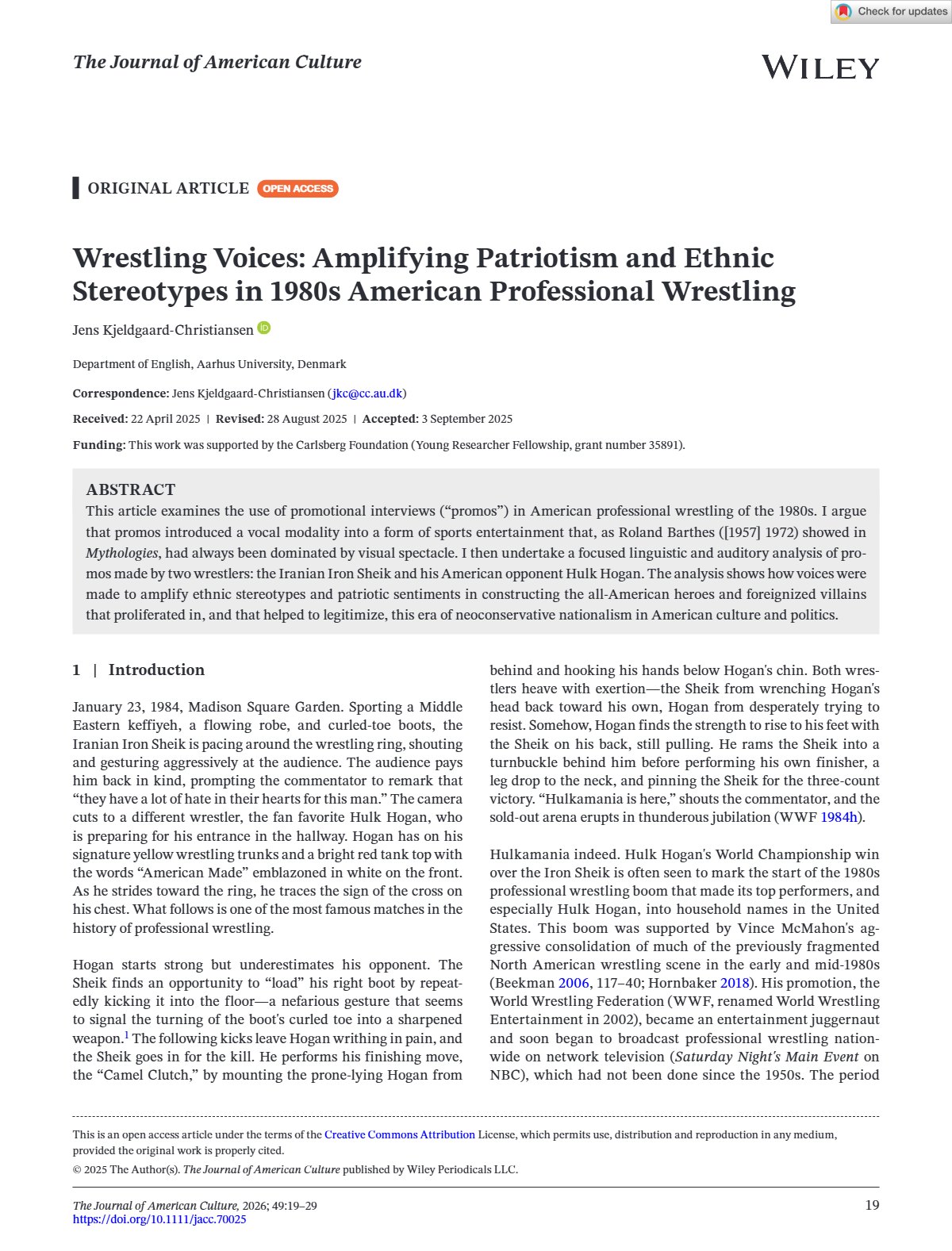
Kjeldgaard-Christiansen, J. (2026). Wrestling Voices: Amplifying Patriotism and Ethnic Stereotypes in 1980s American Professional Wrestling. Journal of American Culture 49(1): 19–29. DOI
Analyzes the promotional interviews (“promos”) of 1980s American professional wrestling, focusing on the Iron Sheik and Hulk Hogan, to show how voice was made to amplify ethnic stereotypes and patriotic sentiment. These performances helped build the all-American heroes and foreignized villains of an era of neoconservative nationalism.
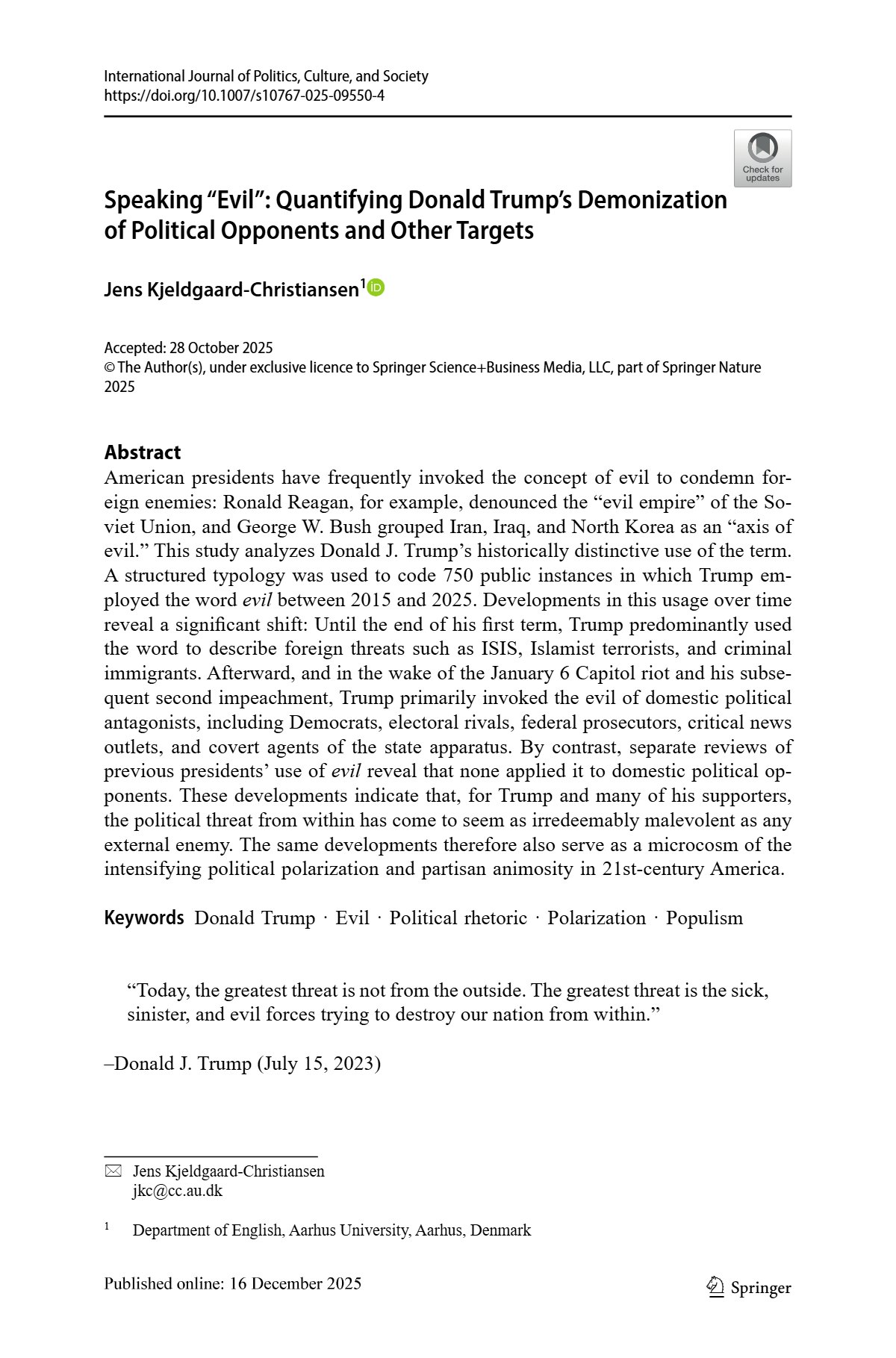
Kjeldgaard-Christiansen, J. (2025). Speaking “Evil”: Quantifying Donald Trump’s Demonization of Political Opponents and Other Targets. International Journal of Politics, Culture, and Society (early view). DOI
Codes 750 instances in which Trump used the word “evil” between 2015 and 2025, finding a shift from foreign threats to domestic political opponents such as Democrats, prosecutors, and critical news outlets. No earlier president used the word this way, which the article reads as a sign of rising political polarization.
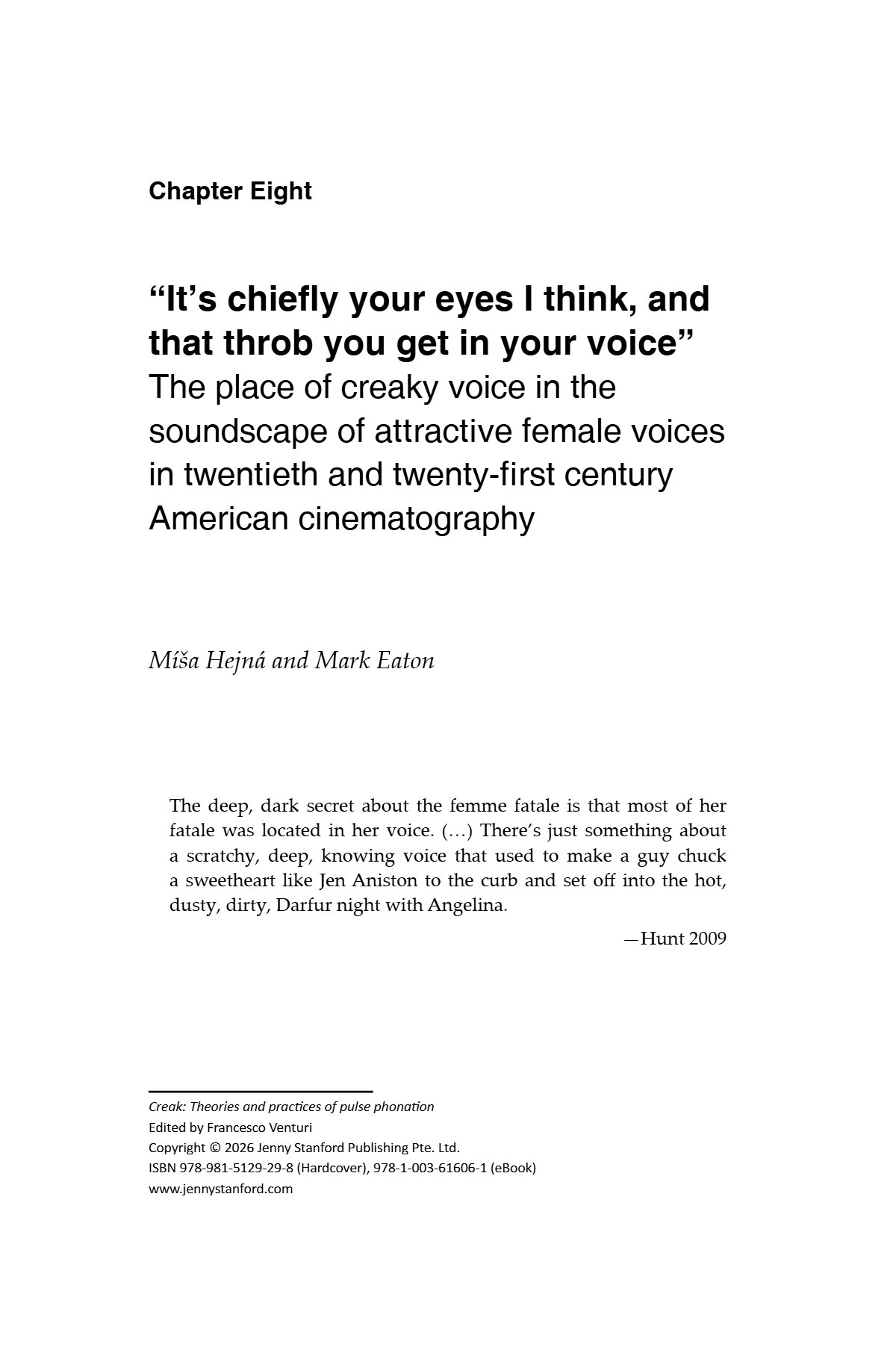
Hejná, M. & Eaton, M. (2025). “It’s chiefly your eyes I think, and that throb you get in your voice”: The Place of Creaky Voice in the Soundscape of Attractive Female Voices in Twentieth and Twenty-First Century American Cinematography. In Creak: Theories and Practices of Pulse Phonation, ed. Venturi. Jenny Stanford Publishing.
Examines the voices of femme fatale characters in American cinema from the 1950s to the 2010s, asking whether creaky voice helps construct the persona. It finds that it does not: creak grows more frequent in recent films but mostly signals a negative stance or emotional turmoil, while low pitch and higher breathiness are the constant building blocks of the trope.
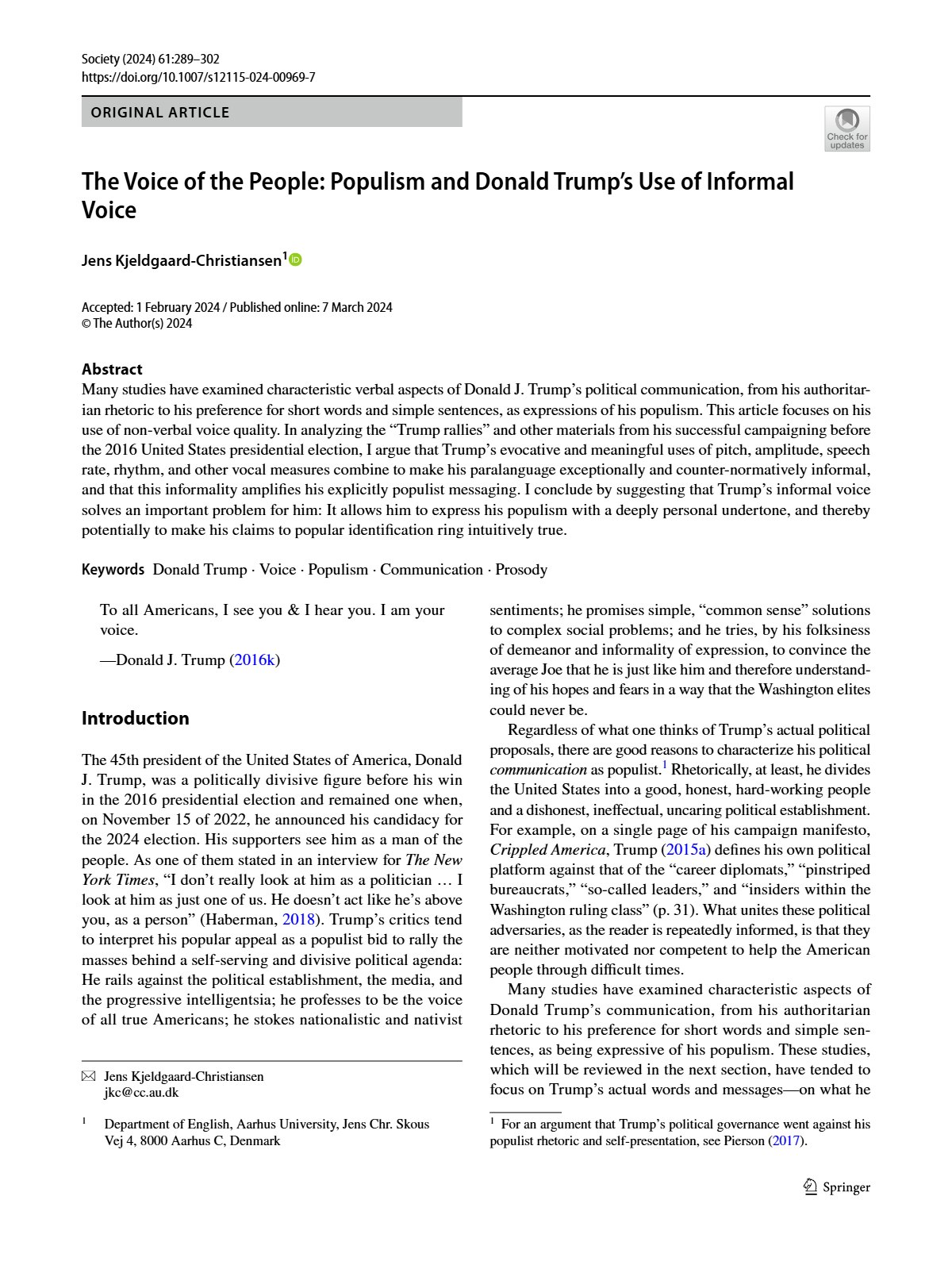
Kjeldgaard-Christiansen, J. (2024). The Voice of the People: Populism and Donald Trump’s Use of Informal Voice. Society 61(3): 289–302. DOI
Analyzes the non-verbal voice quality of Trump’s pre-2016 campaign speeches, arguing that his use of pitch, volume, speech rate, and rhythm makes his delivery exceptionally informal. This informality amplifies his populist message and helps his claims to popular identification ring personally true.
Dalsgaard, I. H. (2024). Keeping Thomas Pynchon Private: The Limits to Studying an “Anonymous” Celebrity. Celebrity Studies 15(1): 107–110. DOI
Asks what Thomas Pynchon’s deliberate anonymity means for celebrity studies and for the critics, fans, and media who engage with him. Drawing on her own experience as editor of two Cambridge volumes on Pynchon, Dalsgaard argues that scholars of living celebrities should be aware of their part in producing and protecting a public image.
Andersen, T. R. (2024). Sous la Plage, Les Pavés: The Beach between Utopia and Dystopia in Thomas Pynchon’s Inherent Vice and Cormac McCarthy’s The Road. In The Literary Beach: History and Aesthetics of a Modern Topos, eds. Meiner & Andersen. Routledge, pp. 77–91. DOI
Reads Pynchon’s Inherent Vice and McCarthy’s The Road against the beach’s literary history as a utopian place, arguing that both novels make utopian alternatives imaginable without fulfilling them. Utopian and dystopian impulses stand side by side, so the era of utopias is not over, but these utopias lack the revolutionary potential some theorists claim.
Kjeldgaard-Christiansen, J., Hejná, M., Clasen, M. & Eaton, M. (2023). Evil Voices in Popular Fictions: The Case of The Exorcist. Journal of Popular Culture 56(2): 226–247. DOI
Asks why the possessed Regan’s voice in The Exorcist registers as evil, and argues that voices seem evil when they come across as impure, sickly, or broken. Drawing on moral metaphors of purity and an acoustic analysis of the film’s noisy, hoarse voice, the authors propose a metaphorical account of evil voices that can also be studied quantitatively.
Hye-Knudsen, M., Kristensen-McLachlan, R. D. & Clasen, M. (2023). How Stephen King Writes and Why: Language, Immersion, Emotion. Orbis Litterarum 78(5): 353–367. DOI
Tests three pieces of advice from Stephen King’s On Writing (simple language, few -ly adverbs, little passive voice) against his own novels using computational linguistics. The advice on simple language makes sense if the goal is to sell books and that on adverbs if the goal is literary recognition, while the advice against the passive has little basis.

Jensen, H. S. (2023). Sesame Street: A Transnational History. Oxford University Press. DOI
Traces the journey of Sesame Street from an American educational television experiment to a globally marketed commodity, despite its producers’ claims of universality. Jensen shows that the program’s fixed assumptions about childhood and education clashed with the views of foreign broadcasters, and that it achieved international success only after its makers rethought its business model and aims.
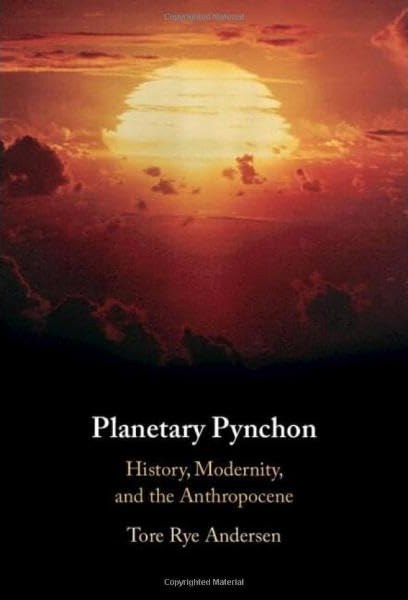
Andersen, T. R. (2023). Planetary Pynchon: History, Modernity, and the Anthropocene. Cambridge University Press. DOI
Reads Pynchon’s major novels as a global trilogy that offers a coherent history of how European modernity spread across the world, with devastating consequences for the planet and its inhabitants. Combining close textual analysis with broader thematic discussion, the book shows how the novels anticipate present concerns about the Anthropocene, environmental destruction, and capitalism’s demand for perpetual growth.
