Stephen Joyce, Aarhus University (January 23, 2026) Download PDF
— President Trump on Greenland, Jan. 9, 2026.
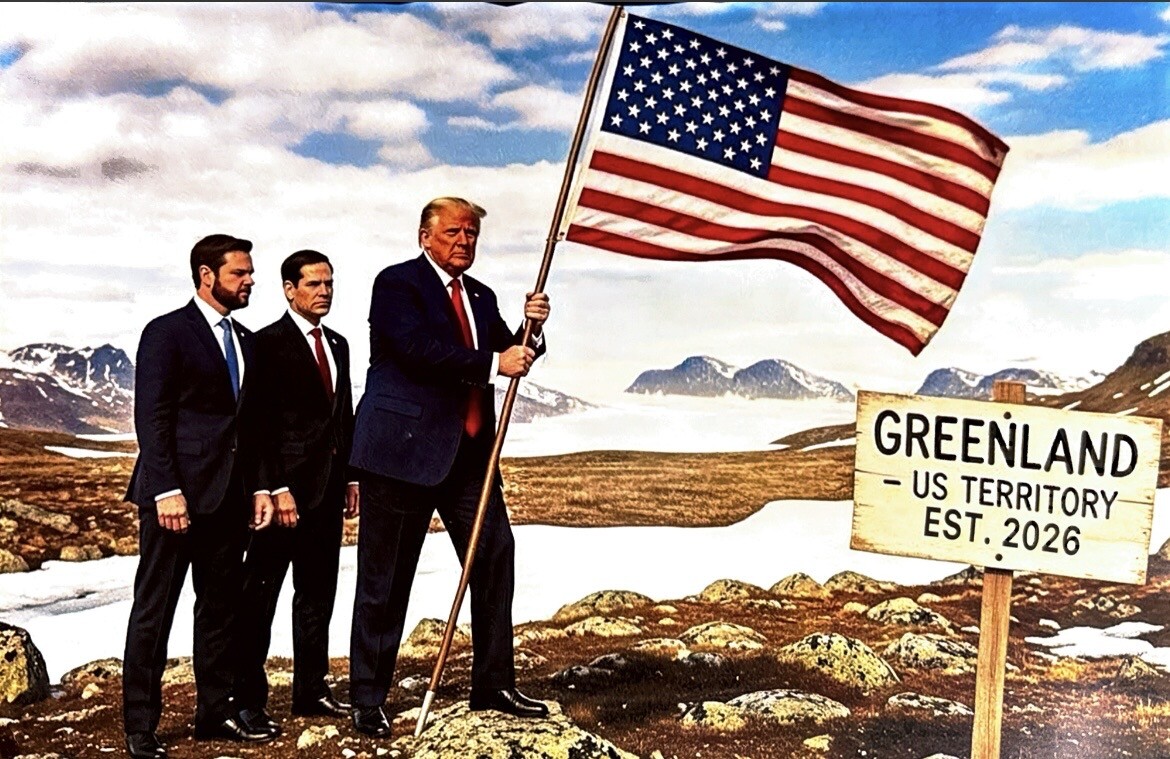
When Donald Trump first floated the idea of acquiring Greenland in August 2019, it was “greeted internationally with widespread hilarity.” At the beginning of 2026, Trump’s renewed demands for US annexation of Greenland have sparked a major international crisis, with several European countries now sending troops to Greenland to protect NATO territory from a potential attack by the United States. The rapid transformation of the USA from “the leader of the free world” to being a significant threat to NATO allies poses profound questions not just for the international order but for the USA’s role in the world and its own self-perception as the world’s great bastion of freedom and democracy.
American exceptionalism has been a leitmotif of American foreign policy ever since the nation began to exert influence on the world stage, but this exceptionalism has two distinct variants. According to Henry Kissinger in Diplomacy, “The first is that America serves its values best by perfecting democracy at home, thereby acting as a beacon for the rest of mankind; the second, that America’s values impose on it an obligation to crusade for them around the world” (1994, 18). Hellmut Lotz defines these attitudes as Isolationism and Leadership:
Isolationism fears the vulnerability of America’s uniqueness through exposure to an alien and corrupt environment … proponents of Leadership focus on America’s moral strength and political power to spread and protect the American way of life … in less fortunate areas of the world. Like the American Dream, Leadership is optimistic and assumes equality among humans, while Isolationism is pessimistic and makes a qualitative distinction between Americans and foreigners. (1997, 82)
These ideas resonate deeply across American culture. When Americans imagine their country acting on the international stage, their narratives typically sketch American exceptionalism in terms of either Isolation or Leadership. In Vietnam-era Hollywood war films such as The Deer Hunter (Cimino 1978), the American heroes are traumatised by their encounter with an alien environment and retreat to the homeland to once again nurture American values; in post-Cold War blockbusters such as Independence Day (Emmerich 1996), the rest of the world waits passively for robust American leadership in defence of freedom.
Within these broad categories, there are still different variants. George W. Bush and the neo-conservatives defined American Leadership in highly militarised terms, imagining that the Iraq War would lead to an expansion of democracy in the Middle East. As the former president put it, “the establishment of a free Iraq at the heart of the Middle East will be a watershed event in the global democratic revolution.” Regardless of how one views the Bush presidency, it continued the tradition of American exceptionalism in arguing that the USA’s unique values were the driver of its foreign policy: “The advance of freedom is the calling of our time; it is the calling of our country. From the Fourteen Points to the Four Freedoms, to the Speech at Westminster, America has put our power at the service of principle. We believe that liberty is the design of nature; we believe that liberty is the direction of history.”
What is distinctive about Donald Trump is that he is the first American president to deny the idea of an American exceptionalism rooted in values of liberty and democracy. When he first ran for president, his landmark 2016 “America First” speech outlining his foreign policy views was described as neo-Isolationist because he ran against the excesses of the Iraq War, proclaiming that “instead of trying to spread universal values that not everybody shares or wants, we should understand that strengthening and promoting Western civilization and its accomplishments will do more to inspire positive reforms around the world than military interventions.” While this shares some features of Isolationism, it does not define American values as being about liberty and democracy; instead, it substitutes “Western civilization,” which, among Trump’s many supporters on the far-right, indicates a defence of white Christian nationalism.
A close reading of this key speech highlights something unusual for an American presidential candidate. Trump does not extol the USA as a country of exceptional values. Instead, he defines and defends his foreign policy solely in terms of interests: “No country has ever prospered that failed to put its own interests first. Both our friends and our enemies put their countries above ours and we, while being fair to them, must start doing the same. We will no longer surrender this country or its people to the false song of globalism. The nation-state remains the true foundation for happiness and harmony.” In a Fox News interview shortly after becoming president in 2017, Trump defended Vladimir Putin from the accusation that he was a murderer by saying, “We got a lot of killers. What, you think our country’s so innocent?” No other president has argued that not only is the USA not exceptional, it is as morally degraded as a brutal dictatorship. The defence of Putin also presaged Trump’s desired realignment of the USA with Russia, a realignment that would later have serious consequences for Ukraine and NATO.
When Trump became president again in 2025, his inaugural address occasionally extolled American exceptionalism, but in a highly unusual way:
America will reclaim its rightful place as the greatest, most powerful, most respected nation on earth, inspiring the awe and admiration of the entire world. A short time from now, we are going to be changing the name of the Gulf of Mexico to the Gulf of America — (applause) — and we will restore the name of a great president, William McKinley, to Mount McKinley, where it should be and where it belongs (applause.)
For Trump, America’s exceptional nature lies not in its democratic values nor its commitment to freedom. Instead, the examples he reaches for are entirely different: America’s greatness lies not in freedom or democracy but in the possession and display of power – to rename places, rewrite symbols, and extract tribute in ways that aggrandize the nation and its leadership.
.
Trump’s foreign policy actions at the start of 2026 are putting this vision into action. The seizure of Venezuelan dictator Nicolás Maduro was not justified in terms of spreading democracy but primarily in terms of claiming Venezuelan oil. Likewise, his threats to annex Greenland are not couched in terms of spreading American values. In Trump’s worldview, Denmark and Europe generally owe him Greenland as tribute:
We have subsidized Denmark, and all of the Countries of the European Union, and others, for many years by not charging them Tariffs, or any other forms of remuneration … Now, after Centuries, it is time for Denmark to give back.
Despite an overwhelming majority of Americans opposing the annexation of Greenland, Congress has shown itself unwilling to exercise its constitutional power and restrain the president. Trump’s threatened tariffs against European countries who oppose him are a case in point. International trade expert and Nobel Prize-winning economist Paul Krugman has explained that the president can only announce tariffs in specific, limited circumstances, but neither the Republican-controlled Congress nor the Republican-dominated Supreme Court have shown any willingness to enforce the checks and balances on which American democracy rests. If Trump’s initial request to buy Greenland in 2019 was a joke, this was because the balance of powers still operated; today, in their absence, the same demand has to be treated with deadly seriousness. This supine deference to the presidency has allowed the “Putinization” of American foreign policy, with Trump’s claims on Greenland mirroring Putin’s claims on Ukraine.
From a global perspective, the USA has now permanently abdicated any claim to being the “leader of the free world.” The original purpose of NATO was to prevent (Soviet) Russian expansion in Europe. Not only has Trump stopped defending Ukraine in its fight against Russia’s war of conquest, he is now also threatening to attack Europe from the West. America’s allies are now scrambling to construct a new security order that does not depend on the USA, which has proven itself to be unreliable.
Beyond the immediate crisis, this dramatic shift to a post-American world order will also have long-term implications for the USA’s own self-image. It is hard to imagine some future version of The Deer Hunter in which traumatized veterans return from Greenland to restore their sense of values in the safety of a Minnesota overrun by ICE raids. The vision of American leadership in films such as Independence Day would be actively booed out of international cinemas today. The iconic “Team America” anthem already seems like something from a bygone era. How will American culture react to the idea that they are no longer the good guys, and that their country – far from being a land consecrated to the values of freedom and democracy – seems all too willing to acquiesce to dictatorial rule and realist power politics? Whatever the answer, it is difficult to imagine any version of American exceptionalism surviving Trump’s presidency.
References
Kissinger, Henry. 1994. Diplomacy. London: Touchstone.
Lotz, Hellmut. 1997. “Myth and NAFTA: The Use of Core Values in US Politics.” In Culture & Foreign Policy, edited by Valerie M. Hudson, 73–96. London: Rienner.
